
From the Imperial Kitchens of Hue – The Preserved Delicacies That Survived Centuries
By Chi itxeasy - 13/03/2026 - 0 comments
A City Built on Refinement
There is a particular quality to the food culture of Hue that visitors notice almost immediately — a deliberateness, a precision, an insistence on beauty in even the smallest detail that feels different from the bold, generous, improvisational energy of Vietnamese cooking elsewhere in the country.
This is not coincidence. It is history.
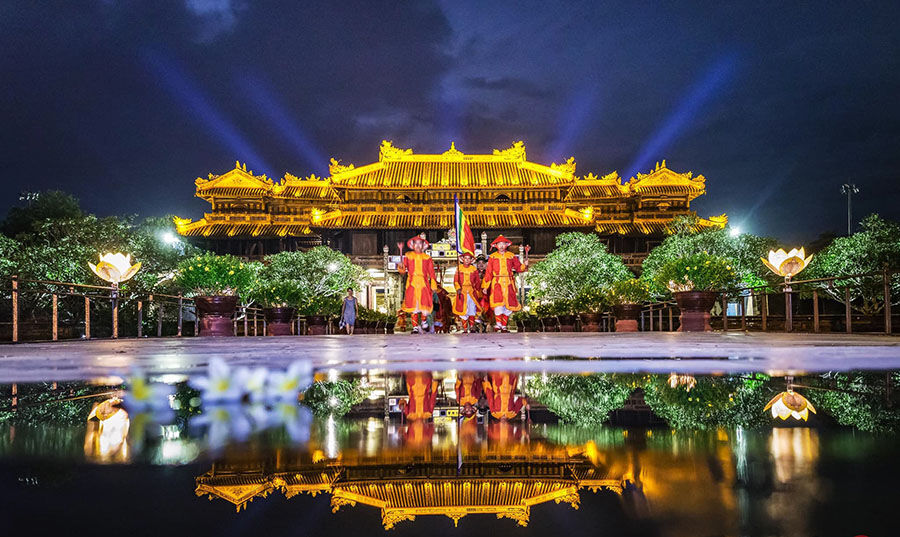 Hue served as the imperial capital of Vietnam under the Nguyen Dynasty from 1802 to 1945 — the last ruling dynasty of a unified Vietnamese kingdom, and one of the most culturally sophisticated courts in Southeast Asian history. For nearly one hundred and fifty years, the city on the banks of the Perfume River was the political, cultural, and culinary center of the Vietnamese world. Everything that happened within the walls of the Imperial Citadel — including, and perhaps especially, the food — was expected to meet standards of quality and refinement that reflected the dignity of the throne.
The imperial kitchen of Hue was not merely a place where food was prepared. It was an institution — staffed by specialists, governed by protocols, and dedicated to the proposition that cooking was a form of art no less serious than painting, poetry, or music. The dishes that emerged from those kitchens over generations were not simply recipes. They were expressions of a civilization's relationship with flavor, beauty, and the natural world.
Most of those dishes are now history. The dynasty ended. The court dispersed. The imperial kitchen closed.
But some of what was created there — the techniques, the flavor principles, the meticulous approach to preservation — survived. Passed down through families, maintained by artisans in Hue's surrounding communities, and practiced today by producers who understand that what they are making carries the weight of something much older than themselves.
Candied Garden Egg is one of those survivals.
What the Imperial Court Ate — And Why Preservation Mattered
To understand why preserved foods occupied such an important place in Hue's imperial food culture, it helps to understand the logic of royal Vietnamese cuisine more broadly.
The imperial kitchen operated under a philosophy of balance and contrast — the idea that a truly refined meal should offer the diner a complete range of sensory experiences, including flavors and textures that complemented and offset one another. Rich dishes needed clean, sharp counterpoints. Heavy proteins needed light, acidic accompaniments. Elaborate preparations needed simple, honest ingredients to provide relief.
Preserved and pickled vegetables served this balancing function — but in Hue's imperial kitchen, they were elevated far beyond the utilitarian function they served in ordinary Vietnamese cooking. Where a village kitchen might produce a simple fermented vegetable for its practical preservation value, the imperial kitchen approached the same ingredient with the full attention of trained specialists — developing techniques that transformed humble vegetables into refined delicacies worthy of the royal table.
The garden egg — known in Vietnamese as cà pháo, a small round eggplant variety distinct from the elongated purple eggplant familiar in Western markets — was among the ingredients that received this treatment. Its natural bitterness, considered a liability in ordinary cooking, became in the hands of Hue's culinary specialists a starting point for a multi-stage process of transformation — one that would take the humble vegetable through careful debitterment, precise sweetening, and controlled preservation to produce something entirely different from what nature had provided.
The result was a preserved delicacy with a translucent amber appearance, a satisfying crunch that held through months of storage, and a flavor profile of balanced sweet and sour notes that the imperial kitchen prized as both a standalone accompaniment and a palate-cleansing element in elaborate multi-course meals.
The Art of Hue Preserving — A Technique Rooted in Patience
What distinguishes Hue-style preservation from ordinary pickling or candying elsewhere in Vietnam — and from the preserved vegetable traditions of other Asian culinary cultures — is its insistence on complete transformation of the ingredient rather than merely extending its shelf life.
The process of producing candied garden egg in the Hue tradition begins with careful selection of the right variety of cà pháo at the right stage of ripeness — a judgment that experienced producers make by eye and touch, drawing on accumulated knowledge of how the fruit's cellular structure at different stages of development will respond to the preservation process.
The raw garden egg carries a significant natural bitterness — a compound concentrated in the skin and flesh that, left untreated, would make the finished product unpleasantly harsh. The first and most critical stage of the Hue preservation method is debitterment — a patient, multi-step process that draws out this bitterness through a combination of salting, soaking, and careful timing, without damaging the fruit's structural integrity or stripping away the natural flavor compounds that will carry the finished product's character.
This debitterment stage is where the technique is most demanding and most consequential. Too little treatment and residual bitterness compromises the finished flavor. Too aggressive a treatment and the fruit loses the cellular firmness that produces the characteristic crunch. The balance is achieved through experience — through the kind of accumulated craft knowledge that cannot be learned from a recipe but only from repeated practice under the guidance of someone who already knows.
Once debitterment is complete, the garden egg undergoes the candying process — a controlled introduction of sweetness and acidity through a sugar solution with careful pH management that gradually penetrates the fruit's cellular structure, replacing moisture with a balanced sweet-sour medium while the natural pectin in the fruit skin contributes to the translucent, jewel-like appearance that is the visual hallmark of well-made Hue candied garden egg.
The finished product — translucent, amber-toned, firm, and balanced in flavor — is the product of a process measured in days rather than hours. It cannot be rushed without compromising the result. This is preserved food as craft, not as industrial production.
What Survived the Fall of the Dynasty
When the Nguyen Dynasty ended in 1945 with Emperor Bao Dai's abdication, the institutional structures of imperial Hue dissolved — the court, the bureaucracy, the formal hierarchies that had organized Vietnamese elite culture for a century and a half. The imperial kitchen, as an institution, ceased to exist.
But the knowledge it had concentrated did not disappear entirely. It dispersed — carried outward by the families of former court servants, artisans, and cooks who had spent their working lives within the imperial system and who settled in Hue's surrounding communities, continuing to practice the techniques they knew because those techniques were part of who they were.
Hue today remains a city with a distinctive food culture that is recognizably descended from its imperial heritage — more refined, more detail-oriented, and more invested in the aesthetics of food presentation and flavor balance than Vietnamese cooking elsewhere. The preserved foods of Hue — candied fruits, pickled vegetables, and traditional condiments made according to methods that trace their lineage to the imperial kitchen — are part of that living heritage.
They are made in smaller quantities than industrial preserved foods. They require more time and skill to produce than conventional pickled products. And they carry a flavor complexity and cultural authenticity that no industrially produced equivalent can replicate.
For international buyers — whether in specialty food retail, luxury hospitality, or premium gifting — this is precisely the kind of provenance story that the market is increasingly willing to pay for.
Why This Matters for Global Food Markets in 2026
The international specialty food market is in the middle of a significant shift in what buyers and consumers find compelling. The era of generic "Asian food" as a category is giving way to a more sophisticated appetite for specific regional food traditions, authenticated cultural provenance, and the kind of craft production story that connects a product to a particular place, time, and tradition.
Japanese regional food culture has led this trend in global markets for years — the premium positioning of specific regional sake, pickles, and preserved foods from particular prefectures is a mature and commercially sophisticated phenomenon. Korean food culture is following a similar trajectory. And Vietnamese food — long known internationally primarily through a handful of widely replicated dishes — is beginning to attract the more discerning attention that its extraordinary regional diversity deserves.
Hue's imperial food heritage is one of the most compelling and least commercially developed stories in Vietnamese culinary culture for international markets. The combination of historical depth, genuine craft tradition, distinctive flavor profiles, and visual beauty that characterizes Hue's preserved food traditions is almost perfectly aligned with what premium specialty food buyers, luxury hospitality operators, and high-end food gift curators are looking for.
Candied garden egg — translucent, amber, jewel-like, with a flavor story rooted in the imperial kitchens of Vietnam's last dynasty — is among the most distinctive entries in that tradition.
For Buyers, Importers, and Hospitality Partners
ITX Easy supplies premium candied garden egg produced in the Hue tradition — carefully processed to export standards, hygienically packaged, and available with full export documentation for international buyers.
We work with specialty food importers, Asian cuisine restaurant operators, premium food gift producers, and private label partners looking to bring genuine Vietnamese culinary heritage to international markets.
Contact and Inquiry
- WhatsApp: +84 52 373 4193
- Email: info@itxeasy.com
- Website: www.itxeasy.com
Custom packaging, private label, and wholesale supply available. Sample requests welcome.
Tags: Imperial Hue cuisine, Hue royal food, Vietnamese preserved food, candied garden egg, cà pháo, Hue culinary heritage, Vietnamese food culture, specialty food import, luxury food gifting, Asian preserved delicacy, Nguyen Dynasty food, Vietnamese food history, premium food Vietnam, traditional preservation technique, Hue food export, specialty food retail, cultural food story, artisan preserved food, Vietnamese heritage food, food gifting Vietnam
Latest

DRIED EUCHEUMA SEAWEED
🌿 PRODUCT DESCRIPTION Dried Eucheuma Seaweed is produced from the fresh body of high-quality red ..

Frozen Gac Fruit Flesh
Frozen Gac Fruit Flesh is made from the fresh red membrane of ripe Gac fruit (Momordica cochinchinen..

DRIED SOURSOP LEAVES
SOURCE DRIED SOURSOP LEAVES FROM VIETNAM Dried Soursop Leaves are made from carefully selected fr..

Freeze-Dried Pandan Leaf Powder
Freeze-Dried Pandan Leaf Powder — Natural. Aromatic. Vibrant. Our freeze-dried pandan leaf powder..

CUTTLEFISH BONE (CUTTLEBONE)
Cuttlefish bone (also known as cuttlebone) is the internal hard shell of cuttlefish, with a natural ..

Processed Pineapple Leaf Fiber
Processed Pineapple Leaf Fiber (PALF) – Sustainable & High-Value Material Our processed pinea..

Eco-Friendly Pineapple Enzyme Dishwashing Liquid
Eco-Friendly Pineapple Enzyme Dishwashing Liquid – Natural & Sustainable Cleaning Our pineapp..

Anchovy Fish Sauce
Premium Anchovy Fish Sauce – Traditional Fermented Flavor from Vietnam Our premium anchovy fish s..

Dried Bitter Melon Vine (Dây Khổ Qua Khô)
Dried bitter melon vine (Momordica charantia) is a time-honored herbal remedy in traditional Vietnam..

Premium Terracotta Pottery from Vietnam – Handmade Natural Clay Products for Europe
Premium Terracotta Pottery – Natural Handmade Clay Products Our premium terracotta pottery from V..

Vietnamese Natural Ramie Leaves Powder (Bot La Gai Den)
Introduce your products to the authentic taste and color of Vietnam with ITXEasy's Natural Ramie Lea..

Vietnamese Boiled Sweet Potato — Nature's Most Honest Snack
Vietnamese Boiled Sweet Potato — Nature's Most Honest Snack No seasoning. No packaging. No brandi..