
Artisan Bio-Paper vs Regular Paper – What Makes It Different?
By Chi itxeasy - 13/03/2026 - 0 comments
The Paper on Your Desk Has a Story Most People Never Think About
Pick up any sheet of conventional office paper, packaging tissue, or printed card and consider for a moment what it actually is — and how it got there.
It started as a tree. Then it went through pulping with chemicals including chlorine compounds and sodium hydroxide. Then bleaching. Then pressing, drying, coating, and cutting at industrial scale — a process that consumes enormous quantities of water and energy, generates significant chemical waste, and produces a material that is, in the end, remarkably uniform, sterile, and entirely disconnected from anything natural.
This process has been refined over more than a century to produce paper that is cheap, consistent, and functional. It has served the world well. But it has also left a trail of environmental consequences that modern brands, designers, and packaging buyers are increasingly unwilling to ignore.
Artisan Bio-Paper offers a fundamentally different answer — not just to the question of what paper is made from, but to the question of what paper can be.
What Is Regular Paper, Really?
To understand what makes bio-paper different, it helps to understand what conventional paper actually involves.
Standard commercial paper — whether used in printing, packaging, or stationery — is produced almost universally from wood pulp. Trees are harvested, chipped, and chemically broken down to separate cellulose fibers from lignin and other organic compounds. The resulting pulp is bleached to achieve a white color, then pressed into sheets, dried, and finished with various surface treatments depending on the intended application.
The environmental footprint of this process is substantial. Global paper production is one of the largest industrial consumers of fresh water worldwide. The bleaching process traditionally relies on chlorine-based chemicals that generate toxic byproducts. And while many paper manufacturers have made genuine progress toward more sustainable forestry and processing practices, the fundamental model remains extractive and energy-intensive at its core.
Conventional paper is also, by design, engineered for uniformity. Every sheet is identical. That is a functional advantage for industrial applications — but it also means that conventional paper has no character, no texture variation, and no story beyond its technical specifications.
 What Is Artisan Bio-Paper?
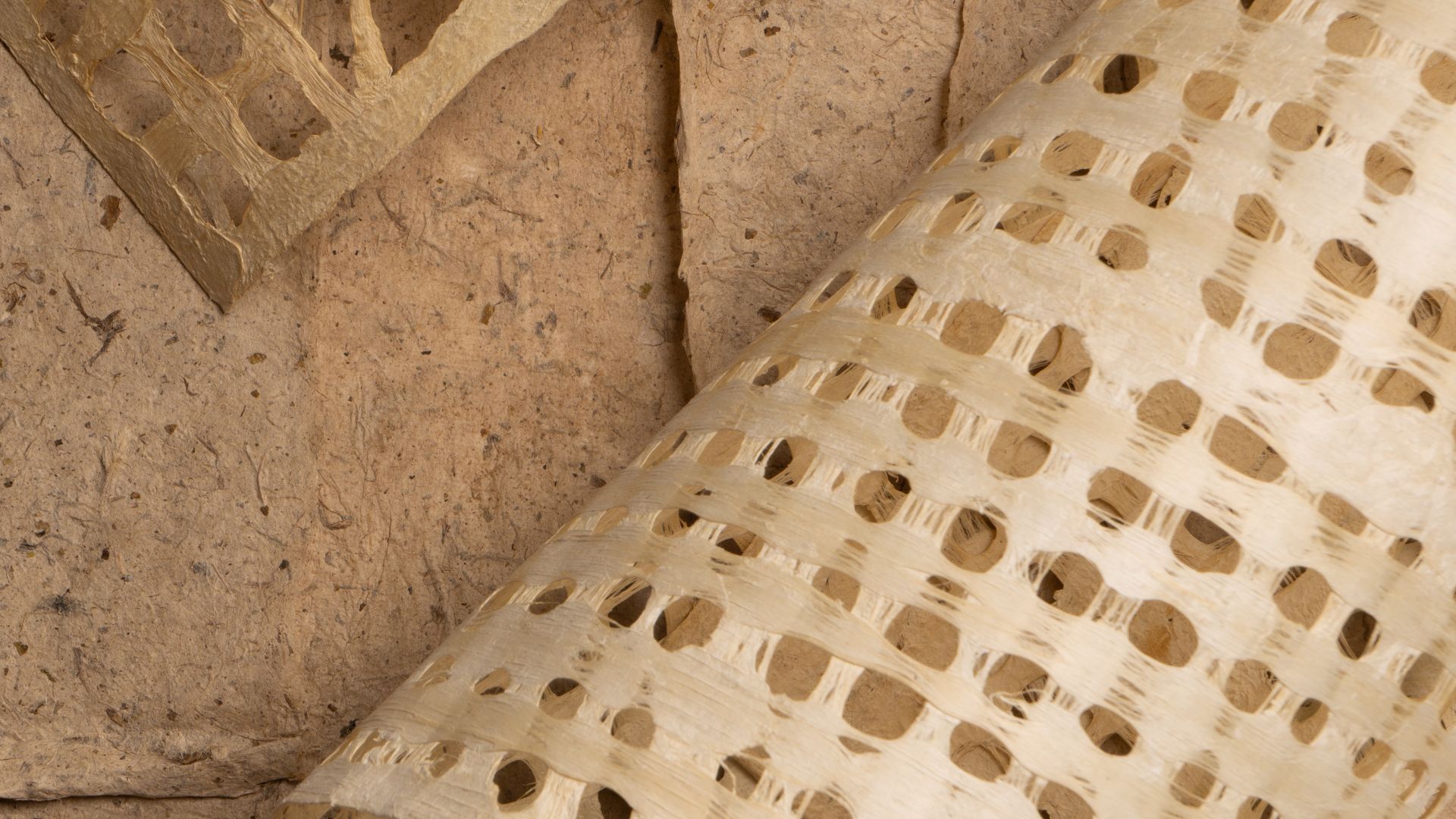
Artisan Bio-Paper is handcrafted paper produced from natural plant fibers — materials sourced from agricultural plants and botanical sources rather than harvested timber. In Vietnam, where ITX Easy produces its bio-paper, the raw fiber sources include plant materials from the country's rich tropical agricultural base, processed using traditional papermaking methods that have been practiced and refined over generations.
The production process is fundamentally different from industrial paper manufacturing at every stage:
Raw material sourcing — plant fibers are collected from natural and agricultural botanical sources, often utilizing parts of plants that would otherwise go to waste, supporting circular use of agricultural resources.
Fiber preparation — fibers are cleaned, softened, and prepared using minimal chemical intervention, preserving the natural character of the plant material rather than stripping it away.
Sheet formation — fiber is suspended in water and hand-formed into sheets using traditional frame and screen methods, a process that creates the natural texture variation and organic surface character that defines handmade paper.
Drying — sheets are dried naturally or with gentle heat, without the industrial pressing and coating processes that give conventional paper its uniform surface.
Finishing — minimal finishing preserves the natural surface, weight, and texture of the material, resulting in a sheet that carries the visible and tactile character of its plant fiber origin.
Side by Side — The Key Differences
| Regular Industrial Paper | Artisan Bio-Paper | |
|---|---|---|
| Raw material | Wood pulp from harvested timber | Natural plant fibers – botanical and agricultural sources |
| Production method | Heavy industrial chemical processing | Traditional handcraft techniques |
| Chemical use | Significant – bleaching, pulping agents | Minimal – natural fiber preparation |
| Texture | Uniform, smooth, engineered | Naturally varied, organic surface character |
| Appearance | Consistent white or coated finish | Natural plant fiber tones, subtle variation |
| Environmental profile | High water and energy consumption | Low-impact, often circular material use |
| Biodegradability | Varies – treated papers may resist degradation | Fully biodegradable – natural fiber composition |
| Character | Functional, neutral | Distinctive, craft-quality, visually unique |
| Storytelling value | None | Rich – origin, craft tradition, sustainability |
| Best for | Mass production, uniformity-critical applications | Premium packaging, design, stationery, gifting |
The Texture Difference Is Not a Minor Detail
For brands operating in premium packaging, luxury retail, artisan stationery, and creative design, the surface character of bio-paper is not simply an aesthetic preference — it is a functional brand communication tool.
When a customer receives a product wrapped in handmade bio-paper, the tactile experience communicates something that printed text on a conventional box cannot: that the brand cares about materials, that the product inside has been given thoughtful consideration, and that the transaction carries a values dimension beyond pure commerce.
This is increasingly what premium and conscious consumers are paying for. In an era where packaging has become a primary brand touchpoint — particularly for e-commerce and direct-to-consumer businesses — the material itself tells a story before the product is even seen.
Artisan bio-paper tells a compelling one.
The Environmental Difference Goes Beyond Biodegradability
Both artisan bio-paper and conventional paper can be described as biodegradable in basic terms. But the environmental comparison goes considerably deeper than end-of-life behavior.
The production of conventional paper — from forestry through chemical processing through industrial finishing — generates a cumulative environmental footprint that bio-paper production does not replicate. Plant fiber bio-paper utilizes materials from agricultural and botanical sources that are renewable on much shorter cycles than timber. The processing is low-energy and low-chemical by comparison. And in many cases, the plant fiber sources represent materials that would otherwise be agricultural waste — creating genuine circular economy value rather than simply replacing one primary material source with another.
For brands with sustainability commitments, ESG reporting obligations, or consumer-facing environmental claims, this upstream production difference matters — not just the recyclability or compostability of the finished product.
Where Regular Paper Still Has the Advantage
Honest comparison requires acknowledging where conventional paper remains the more practical choice.
For high-volume, price-sensitive applications where absolute color consistency and surface uniformity are technically required — mass-market commercial printing, food packaging with strict barrier specifications, or industrial applications requiring precise dimensional stability — conventional industrial paper is purpose-built for those requirements in ways that handcrafted bio-paper is not designed to match.
Bio-paper is not a replacement for every paper application. It is a premium material for applications where quality, character, sustainability, and brand story matter more than lowest-cost uniformity.
Who Is Artisan Bio-Paper For?
The buyers and brands finding the most value in artisan bio-paper share a common characteristic — they are building products and brand experiences where the material is part of the message.
- Sustainable packaging brands replacing conventional tissue paper, gift wrap, and packaging inserts with eco materials that reinforce their values positioning
- Premium retail and e-commerce brands elevating unboxing experiences with distinctive, natural-textured wrapping materials
- Stationery and paper goods companies building eco product lines with genuine handmade craft character
- Artists and designers seeking papers with authentic texture and organic variation for illustration, print, and mixed media work
- Corporate sustainability programs transitioning branded stationery and gifting materials to verifiably eco-responsible alternatives
- Hospitality and interior design using natural fiber paper in decorative, amenity, and environmental design applications
Sourcing Artisan Bio-Paper From Vietnam
Vietnam's combination of tropical plant diversity, strong artisan craft tradition, and cost-competitive skilled production makes it one of the most compelling sources for handmade bio-paper in the global market. ITX Easy works with Vietnamese artisan producers to supply consistent, export-ready bio-paper with the quality documentation and supply reliability that international buyers require.
Our bio-paper is available in multiple formats, sizes, and surface finishes — with custom specifications, private label options, and OEM production available for brands building their own eco material ranges.
Contact and Inquiry
Our team is ready to assist with product samples, custom specifications, pricing, and shipping documentation.
- WhatsApp: +84 52 373 4193
- Email: info@itxeasy.com
- Website: www.itxeasy.com
Custom sheet sizes, surface finishes, and OEM production available. Sample requests welcome.
Tags: bio paper, artisan paper, handmade paper, regular paper comparison, eco paper, natural fiber paper, sustainable packaging, biodegradable paper, plant fiber paper, Vietnamese handmade paper, eco brand material, packaging material guide, paper sustainability, craft paper, premium packaging, stationery material, green packaging, circular economy material, paper sourcing guide, Vietnam export material
Latest

Frozen Gac Fruit Flesh
Frozen Gac Fruit Flesh is made from the fresh red membrane of ripe Gac fruit (Momordica cochinchinen..

DRIED SOURSOP LEAVES
SOURCE DRIED SOURSOP LEAVES FROM VIETNAM Dried Soursop Leaves are made from carefully selected fr..

Freeze-Dried Pandan Leaf Powder
Freeze-Dried Pandan Leaf Powder — Natural. Aromatic. Vibrant. Our freeze-dried pandan leaf powder..

CUTTLEFISH BONE (CUTTLEBONE)
Cuttlefish bone (also known as cuttlebone) is the internal hard shell of cuttlefish, with a natural ..

Processed Pineapple Leaf Fiber
Processed Pineapple Leaf Fiber (PALF) – Sustainable & High-Value Material Our processed pinea..

Eco-Friendly Pineapple Enzyme Dishwashing Liquid
Eco-Friendly Pineapple Enzyme Dishwashing Liquid – Natural & Sustainable Cleaning Our pineapp..

Anchovy Fish Sauce
Premium Anchovy Fish Sauce – Traditional Fermented Flavor from Vietnam Our premium anchovy fish s..

Dried Bitter Melon Vine (Dây Khổ Qua Khô)
Dried bitter melon vine (Momordica charantia) is a time-honored herbal remedy in traditional Vietnam..

Premium Terracotta Pottery from Vietnam – Handmade Natural Clay Products for Europe
Premium Terracotta Pottery – Natural Handmade Clay Products Our premium terracotta pottery from V..

Vietnamese Natural Ramie Leaves Powder (Bot La Gai Den)
Introduce your products to the authentic taste and color of Vietnam with ITXEasy's Natural Ramie Lea..

Vietnamese Boiled Sweet Potato — Nature's Most Honest Snack
Vietnamese Boiled Sweet Potato — Nature's Most Honest Snack No seasoning. No packaging. No brandi..

Boi Loi Powder (Red Glue Wood Powder) — Premium Natural Binder from Vietnam
Boi Loi Powder, also known commercially as Red Glue Wood Powder (bot keo do), is a finely milled nat..